
Why Isn't Chicago Building Enough Homes? Inside the 2026 Housing Supply Squeeze
Chicago needs more housing choices, yet fewer new residential projects are entering the development pipeline. Here's what current permit activity, zoning, two-flat losses, office conversions, ADUs, and neighborhood-scale development mean for Chicago buyers.
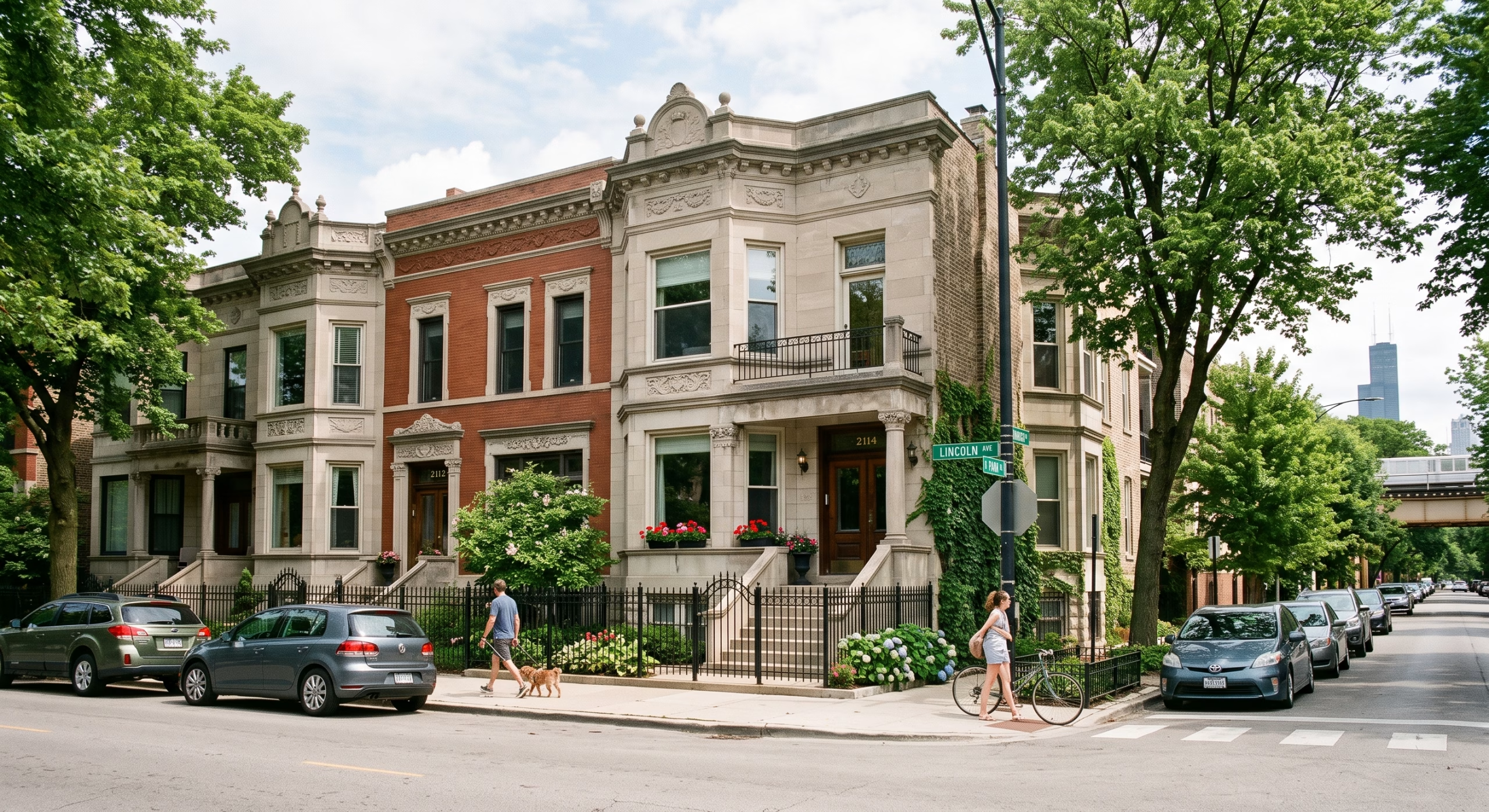
Chicago is not building too few homes because of one single barrier. New housing must work legally, physically, and financially. Zoning, land, financing, construction costs, approvals, property values, and expected rents or sale prices all interact. In 2026, the clearest warning is that substantially fewer new residential projects are entering the city's permit pipeline.
Jump to a section
Is Chicago Really Building Fewer Homes in 2026?
Through September 15, 2026, Chicago recorded 872 new residential construction applications, compared with 1,110 during the comparable period of 2025. That represents a 21.4% decline.
August produced only 45 new residential filings, the lowest monthly figure in the permit dataset going back to 2016.
But applications and issued permits measure different parts of the development process. An application shows a new project entering review. A permit issued represents a project that has already progressed further through the system.
| Housing Pipeline Signal | 2026 Reading | What It Tells Us |
|---|---|---|
| New Chicago residential applications | Down 21.4% through Sept. 15 | Fewer new projects are entering the front of the pipeline. |
| Chicago residential permits issued | Down 3.9% | Projects already in the system are moving considerably more steadily. |
| Chicago-metro residential permitting | Down 18.6% YoY through July | The broader regional construction environment has also weakened. |
Zillow's separate analysis of Census Bureau permitting data found residential permitting across the Chicago metro area down 18.6% year over year for the 12 months ending July 2026 and 18.5% below the metro's pre-pandemic trend.
Those city and metro statistics should not be merged into a single number because they cover different geographies and methodologies.
The better interpretation is not “Chicago stopped building.” It is that fewer new residential projects are entering the pipeline that could become tomorrow's housing.
Why Doesn't Strong Housing Demand Automatically Create More Construction?
A vacant parcel does not automatically become housing because people need homes. The same is true of an empty office building or an underused commercial property.
Before a project moves forward, someone has to determine that it can be acquired, designed, approved, financed, constructed, and either sold or operated under realistic assumptions.
- Land acquisition and site preparation
- Architecture, engineering, and professional services
- Construction financing and carrying costs
- Labor and building materials
- Insurance, taxes, and utilities
- Permits, required improvements, and compliance
- Expected rents or sale proceeds
- Project-specific development risk
Recent Federal Reserve Bank of Chicago discussions with multifamily property owners documented concerns involving insurance premiums, taxes, utilities, equipment, construction labor, rehabilitation costs, and financing.
Those comments reflect the experiences of participating owners rather than proof that any one expense caused Chicago's 2026 construction slowdown.
Housing can be needed and still be difficult to build.
How Does Zoning Affect How Many Homes Chicago Can Build?
Metropolitan Planning Council and Urban Institute research found that 41% of Chicago is zoned for single-family homes or two-flats only, while about 11% is zoned for three- and four-flats and apartment buildings.
The 41% figure does not mean all of that land permits only detached single-family houses. It includes zoning classifications where two-flats are permitted.
It does show how the zoning map can limit additional housing capacity on some parcels. A property may physically accommodate more units while current zoning requires another approval process before that density can be built.
Legal Capacity
What zoning and applicable rules allow to be built on the site.
Physical Capacity
What the lot and existing structure can realistically accommodate.
Financial Feasibility
Whether the completed project can support its total cost and financing.
Why Can Chicago Have Vacant Land and Still Struggle to Add Housing?
This produces one of Chicago's most important housing contradictions.
Some locations contain vacant land but face weaker project economics. Other locations may have stronger property values and buyer or renter demand but relatively limited unused development capacity.
Chicago's Missing Middle Infill Housing Initiative is one effort to use clusters of city-owned vacant parcels for neighborhood-scale housing such as two- and three-flat buildings.
This development model is fundamentally different from a downtown apartment tower. It adds smaller numbers of homes across existing residential blocks rather than concentrating hundreds of units on one site.
The important lesson is not that Missing Middle housing can solve Chicago's entire supply problem.
It is that Chicago needs more than one scale of housing production.
Why Are Chicago's Two-Flats and Three-Flats Part of the Supply Problem?
DePaul University's Institute for Housing Studies found that between 2012 and 2023, Chicago lost nearly 28,000 rental units in two- to four-unit buildings while gaining more than 73,000 rental units in larger multifamily properties.
Rental units in the two- to four-unit category declined by nearly 12% during that period.
That matters because two-, three-, and four-flat properties can provide rental housing, owner-occupancy opportunities, and smaller-scale multifamily ownership.
Considering a two-flat or small multifamily property? Review legal unit count, condition, taxes, insurance, financing, utilities, leases, and property-specific operating assumptions before relying on expected rental income.
Read the Chicago Buyer GuideWhy Are Office-to-Apartment Conversions Trending in Chicago?
The most visible current example is Bellwether Residences at 79 W. Monroe Street.
The project opened in September 2026 after converting portions of the historic Rector Building into 117 apartments, including 41 affordable units.
Bellwether demonstrates that some underused commercial space can become residential supply. It does not demonstrate that every vacant office tower can be converted.
Office-to-residential projects may depend on floor depth, window access, plumbing, elevators, mechanical systems, residential layouts, structural conditions, acquisition cost, financing, and construction expense.
Adaptive reuse expands Chicago's housing toolkit. It does not replace conventional construction.
Can Chicago's Expanded ADU Rules Add Meaningful Housing?
Chicago's expanded Additional Dwelling Unit rules took effect in 2026, broadening opportunities for qualifying coach houses, basement conversions, and other legal additional units.
ADUs work at a very different scale from a large apartment project. Instead of adding hundreds of units at once, they can add housing one property at a time.
Before Paying for “ADU Potential,” Verify the Property
- Current parcel zoning and address-specific eligibility
- Existing building configuration and lot conditions
- Permit and building-code requirements
- Physical construction feasibility
- Financing and available cash
- Applicable occupancy or affordability requirements
- Expected construction and operating costs
Potential development capacity is not the same thing as an existing legal dwelling unit.
What Is Chicago Actually Doing About Housing Supply?
| Approach | What It Can Contribute | Main Limitation |
|---|---|---|
| Conventional construction | Net-new housing at multiple scales | Requires workable land, zoning, financing, and project economics |
| Office conversion | Reuses underutilized commercial buildings | Only certain buildings work physically and financially |
| Missing Middle infill | Neighborhood-scale two- and three-flat housing | Produces fewer units per individual site |
| ADUs | Incremental units on existing properties | Eligibility does not guarantee feasibility or construction |
| Preservation | Keeps existing housing in service | Protects existing supply rather than necessarily producing net-new units |
Different housing types solve different parts of the supply problem.
That is why a single policy or development type should not be treated as a complete answer to Chicago's housing needs.
Will These Strategies Solve Chicago's Housing Shortage?
Housing debates often collapse into one answer:
- Change zoning
- Build more apartments
- Convert offices
- Allow more ADUs
- Build more two-flats
- Preserve existing affordable housing
Each can address part of the issue.
None removes every other constraint.
A site can be zoned for apartments but remain financially infeasible. An office can be mostly vacant but physically unsuitable for residential conversion. A parcel can be ADU-eligible but too expensive to modify. A two-flat can be legal but require extensive repairs that change the purchase economics.
What ultimately matters is not theoretical capacity.
It is how many viable homes actually reach occupancy.
What Does Constrained Chicago Housing Supply Mean for Buyers?
This is where the broader housing story becomes a property-specific decision.
Chicago can have constrained supply overall while individual buyers experience very different conditions depending on price range, property type, location, condition, taxes, insurance, financing, HOA assessments, parking needs, and competing listings.
A downtown condo buyer is not shopping the same inventory as someone looking for a bungalow. A two-flat buyer has different maintenance, financing, legal-use, and operating questions from a single-family buyer.
“Is Chicago short of housing?” is a market question. “How much realistic choice do I have in my budget and property type?” is a buying question.
| Citywide Question | Buyer-Level Question |
|---|---|
| Is Chicago building enough homes? | How many realistic properties are available in my budget? |
| Is new construction slowing? | Is new construction actually part of my search? |
| Are two-flats declining? | What comparable two-flats are available and what condition are they in? |
| Are ADUs becoming easier to build? | Can this specific parcel legally and physically support one? |
| Are office conversions adding units? | Do those projects materially expand my realistic choices? |
| Is overall inventory constrained? | How many genuinely comparable homes am I competing for? |
Want current market context before comparing properties? DEI Realty LLC's market updates separate citywide trends from the property-specific numbers that should drive an individual decision.
View Chicago Market UpdatesThe Market Gives You Context. Your Property Gives You the Answer.
Evidence
Fewer new residential applications are entering Chicago's construction pipeline.
What It Means
Future housing choices could remain constrained if fewer projects eventually reach completion.
What It Could Change
Buyers should put more emphasis on actual inventory, property type, ownership costs, and alternatives.
Citywide data cannot determine whether the home you are considering is fairly priced, financially comfortable, physically sound, or a good fit for your timeline.
That analysis requires property-specific numbers.
Frequently Asked Questions About Chicago Housing Supply
Why isn't Chicago building enough homes?
Chicago housing production is shaped by several interacting factors, including zoning capacity, land, financing, construction costs, approvals, and property-specific economics. Current 2026 data also show substantially fewer new residential applications entering the city's permit pipeline.
Is Chicago home construction declining in 2026?
New residential construction applications were down 21.4% through September 15, 2026 compared with the same period in 2025. Residential permits actually issued declined much less, making the slowdown in new applications the more notable signal.
Is construction slowing across the Chicago metro too?
Zillow's analysis of Census Bureau data found Chicago-metro residential permitting down 18.6% year over year over the 12 months ending July 2026. Metro data should be kept separate from City of Chicago application figures because the geography and measurements differ.
Does zoning restrict new housing in Chicago?
Zoning determines the type and amount of housing that may legally be developed on a parcel. It can limit development capacity, but zoning is only one component of whether an individual project is financially and physically feasible.
Is Chicago losing two-flats?
DePaul's Institute for Housing Studies reports that rental units in Chicago two- to four-unit properties declined nearly 12% between 2012 and 2023, with almost 28,000 rental units lost from this part of the housing stock.
Are office conversions adding housing downtown?
Yes. Projects such as Bellwether Residences demonstrate that suitable office buildings can be converted into housing. Conversions remain building-specific and do not replace the need for other forms of housing development.
Can a Chicago homeowner build an ADU?
Chicago expanded its ADU framework in 2026, but eligibility and requirements depend on the specific parcel, zoning, existing building, and proposed project. Property-specific eligibility should be verified before assuming a coach house or conversion unit can be constructed.
Should I buy now because Chicago isn't building enough homes?
Not based on supply data alone. Buyers should evaluate the inventory available within their budget and property type along with financing, taxes, insurance, condition, total ownership cost, comparable alternatives, and expected timeline.
Turn Chicago Housing Data Into a Property Search That Fits You
Chicago's housing pipeline can explain the market around you. It cannot define your budget, preferred property type, location priorities, ownership costs, or move timeframe.
DEI Realty LLC's buyer tools help organize those criteria before you start comparing individual properties.
Sources & Data Notes
- Transparent City — September 2026 analysis of City of Chicago residential construction filings and permits.
- Zillow — September 2026 analysis of U.S. Census Bureau residential permitting trends.
- Metropolitan Planning Council / Urban Institute — Chicago zoning and housing-capacity research.
- Federal Reserve Bank of Chicago — 2026 multifamily-owner discussions on operating and financing conditions.
- DePaul University Institute for Housing Studies — Chicago rental housing and two- to four-unit housing-stock research.
- City of Chicago and related official project materials — ADU, Missing Middle, preservation, and housing-development program information.
Data reflects the reporting periods stated in the article. City, metro, permit, application, property-type, and affordability measures use different methodologies and should not be treated as interchangeable.
Editorial note: DEI Realty LLC discusses Chicago neighborhoods and housing using objective information about housing supply, property types, costs, transportation, services, infrastructure, amenities, and public programs. DEI Realty LLC does not recommend where someone should live based on race, color, religion, national origin, sex, disability, familial status, or another protected characteristic.
This article provides general educational real estate information and does not constitute legal, tax, mortgage, financial, insurance, zoning, engineering, or investment advice. Verify property-specific information and consult appropriately licensed professionals when necessary. Equal Housing Opportunity.